
Thursday, 21 March 2013

Evaluation - Location & Setting
In our film we used a variety of key locations in order to enhance our film and support the plotline. Choosing the correct location was key to the success of the film, especially in making sure that it didn't look too low budget. We wanted our film to look as professional as possible and I believe that our locations supported this aim to a very great extent, particularly the use of iconic London locations:

The London underground is a very iconic location that is used in a lot of films, most recently the 2012 'Skyfall', which our film takes a lot of inspiration from. This is the first location that the audience sees, and as soon as it comes on they would immediately know where the film is set. I think that we made good use of the location, and even found an interesting grate through which we filmed in order to get one of the shots of 'Jim' walking away. The trouble with this location was that it is frequently very busy, so we filmed this scene last. The underground is very typical of the action genre, as it is an iconic location that has been used in other films in the past.

One of the most famous landmarks in London, Trafalgar Square was the perfect location to give our film that extra bit of production value. It is internationally recognised, so would definitely be one of the key selling points of our film. It follows the conventions of many action films, as a reoccurring factor in action thrillers is the use of big, iconic locations, such as the Kremlin in Mission Impossible: Ghost Protocol, Fort Knox in Goldfinger, the White House in 24 and Mount Rushmore in North by Northwest.
The London Underground
The London underground is a very iconic location that is used in a lot of films, most recently the 2012 'Skyfall', which our film takes a lot of inspiration from. This is the first location that the audience sees, and as soon as it comes on they would immediately know where the film is set. I think that we made good use of the location, and even found an interesting grate through which we filmed in order to get one of the shots of 'Jim' walking away. The trouble with this location was that it is frequently very busy, so we filmed this scene last. The underground is very typical of the action genre, as it is an iconic location that has been used in other films in the past.
Trafalgar Square
One of the most famous landmarks in London, Trafalgar Square was the perfect location to give our film that extra bit of production value. It is internationally recognised, so would definitely be one of the key selling points of our film. It follows the conventions of many action films, as a reoccurring factor in action thrillers is the use of big, iconic locations, such as the Kremlin in Mission Impossible: Ghost Protocol, Fort Knox in Goldfinger, the White House in 24 and Mount Rushmore in North by Northwest.
Evaluation - Title

The title that we chose for our film was 'Sins of the Marytr'. This title is a play on the idiom 'sins of the father', but exchanging 'father' for 'martyr' as rhyme and it still flows just as well. The result of this exchange is an oxymoron - martyr's are usually considered pure, without sins, however here the title is talking about them as if they have sinned. This creates an enigma, leaving the audience wondering how the 'martyr' has sinned, who the marytr is, and why this title has been chosen. Our choice of title is typical of the action genre, in which many films choose complex and enigmatic titles. In particular the James Bond series, who use titles such as 'Tomorrow Never Dies', 'You Only Live Twice' and 'For Your Eyes Only'.
Wednesday, 20 March 2013
Evaluation - Credits Ordering
Here is the order that the credits are written in in our opening two minutes accompanied by a short description detailing our creative decisions:
Universal Pictures
First of all we showed the big production company that was 'behind' our film. This makes the film seem prestigious and the audience gains trust in the film that it will be high quality and high budget.
Studio Canal
Straight after Universal to let people know that it is not a wholly Hollywood dominated film and it still retains it's unique style and an interesting plotline.
Universal Pictures, Studio Canal and Enigma Entertainment present
The inclusion of Enigma Entertainment along side the other two great production companies makes it seem like a very strong production company. The three together let's the audience immediately know who has made the film.

A Film by Nicholas Ashurst and Philip Smith
This is usually the first credit after the production companies. The audience is told from the outset who the main influences are on the creative side of the project.
Lee Davidson
The lead actor in 'Sins of the Martyr' obviously comes first out of the actors as he plays the most important character. The credit appears as his character steps into frame so that the audience make the association.
Nicholas Ashurst
The main supporting actor in the film. The audience don't see him in the opening two minutes, but by putting his name in early they are looking out for him, and they keep watching in order to see him.
James Richardson
Helps the audience to make the association with the character that they have just seen.
Zubin Parekh
Another of the major actors in the film. Later he appears but is not very obvious, so this helps the audience to be on the lookout for him.
With Philip Smith
The 'with' in any acting credits usually goes before a major actor who hasn't got a major role in the film in order to give them prevalence in the credits. Here we did the same thing, so the audience take notice of this credit.
Richard Young
One of the less major actors, so his penultimate placement reflects this.
And Lauren Chambers
The 'and' lets the audience know that the end of the acting credits is nigh so that they watch out for the next credits.

Casting by Nicholas Ashurst and Philip Smith
Straight after the acting credits so that the audience can see who picked the actors whilst they are fresh in their mind.
Costume Design Philip Smith
Moving onto the technical credits. Costume design helps to smooth this transition as it is still a widely acknowledge creative job.
Production Design Nicholas Ashurst
Production design is a close relative to costume design, so it's place is appropriate. Additionally we set it against Horse Guards Parade so that the audience would admire the production design whilst seeing who did it.
Editing by Philip Smith and Nicholas Ashurst
A more technical area that isn't so widely acknowledged as creative.
Score Composed by James Richardson
As the score starts to climax we introduce this credit so that the audience knows who has created it.
"Saints and Sinners" written and performed by Philip Smith
The theme song is the next obvious credit after the film score.
Director of Photography Philip Smith
A very necessary credit to include. The director of photography has control over the look of the film.
Fight and Stunt Co-ordination by Nicholas Ashurst
As a stunt occurs onscreen in prelude to a fight this credit appears to help the audience see who was responsible for it.
Screenplay by Philip Smith
Another extremely important credit.
Based on a Story and Characters by Nicholas Ashurst
This credit makes the story seem more in depth as it has passed through several hands.
Associate Producers James Richardson and Richard Young
This and the next credit are normally used just before the producer credit.
Executive Producers Lee Davidson and Zubin Parekh
The executive producer handles the money, so they have a very high credit. Additionally they are traditionally put directly before the producer in feature films.
Produced and Directed by Nicholas Ashurst and Philip Smith
The traditional final credit that will stick in the audience's mind. By putting it last as it always is in professional films the audience will know where to look for it.
Sins of the Martyr
The title of our film takes up the whole screen so the audience cannot avoid seeing it and knowing that it is the title and of great importance.

Evaluation - Distribution
A production company is a company that invests money into making films and commonly helps with the distribution process as well. They get the most money out of a film as they are the ones that put the money in, and this money then goes towards another project. Many film production companies also produce TV programmes, adverts and games. To get a high budget film made, these companies are usually approached by a screenwriter, director or producer who pitch their ideas. After careful consideration and calculations these films are given the 'green light' and a budget to work on. During the production process the company will keep a close eye on what is going on, to make sure that the film appeals to a wide audience. This can cause a decrease of art films and dramas that are released, as they are not as successful at the box office. Action and science fiction films are usually a safer investment as they attract a wider audience. If a film is financed by a famous production company then they tend to be more successful as the audience trusts them and they have more money to invest in advertising.
For our opening two minutes we have created our own production company in order to give it a more personal feel. This production company is 'Enigma Entertainment', and is one that my co-worker and I have used in the past, significantly in the preliminary task. By using this the audience would be able to tell that it is a film by the same people who made the preliminary task, and this could attract more people. The problem with this is that it might put some people off if they didn't like the Preliminary Task. The name 'Enigma Entertainment' is obviously not very well known, but if people saw it at the beginning of a film it may add to the intrigue. The word 'enigma' brings to mind ideas of mystery and problems, which makes it quite an exciting name for the company. It also helps to highlight the various enigmas in the opening sequence. It also gives the impression that the film will be intelligent, so this can be a bonus when the audience is watching the opening.
We used the 'Universal Pictures' and 'Studio Canal' logos as these are two highly successful production companies that would consider investing in a film such as ours. Universal makes a lot of high budget films and frequently is involved in projects that are similar to ours. The 'Bourne' films have a very similar feel to 'Sins of the Martyr' with their fast paced action sequences and plots full of twists. They were funded by Universal Pictures, so this is a sign that they would be up to funding a film such as ours. 'Sins of the Martyr' would be a very safe investment, as it is an action film, which appeals to a very wide audience. The 2012 film 'Skyfall' is currently the 8th highest grossing film of all time and is very similar to 'Sins of the Marytr', so audience's would be keen to see it after watching 'Skyfall'. Studio Canal tend to make smaller budget films that have a more independent film to them. Being a French company, they allow films to be made without passing through the Hollywood filter. They would be a good company to fund our film as it may be in the style of a high budget thriller, but we would still like to retain the independent film feel that it has. Independent style films appeal to a wide audience, so this would also help in the marketing process. By combining Universal Pictures and Studio Canal we would be able to produce a high budget thriller that does successfully, whilst still retaining an independent style.
Evaluation - Audience Response
Upon the release of our opening two minutes we recieved mixed, yet positive feedback:
'A sin to miss' - James Farmer
'Could easily be a blockbuster film' - Ryan Taylor
'Looks like it has a high production value' - Avraj Chaggar
'A tour de force of an action movie' - Edna Wright
'The camera work created a visual extravaganza' - Dave Leslie
'Blows all other blockbusters out of the water' - Luke Thorne
'A Martyr-piece of modern cinema' - Damien Blake-Morgan
'Storytelling at it's best' - Alfie Tirpitz
Tuesday, 19 March 2013
Evaluation - Storyboard vs Final Opening
Over the course of production on a film, there will of course be a number of
changes, which occur for a number of reasons. During the day of the shoot we
discovered a number of things that could work differently or had to be changed
due to any problems we may have encountered. In this post, I will be detailing
the changes from the storyboard animatic with the final product.


This shot we got very close to, although the final version was much closer to the tunnel then we thought was possible, so this was a very good change. It ended up just as we had visualised it.


In this we decided to switch around the camera angle when they came off the train, this was in order for the following shot to look successful, as there were only little window grates on one side of the roof.


This shot is pretty much exactly how we planned it. Even the position of Davidson's legs is exactly the same as the animatic.


Another very similar shot that worked out exactly how we planned. These two shots are a testament to the intense planning that went into producing the final piece.


Here Davidson is slightly further away than we had hoped so he looks slightly insignificant, but it still looks pretty similar.


Although this shot is slightly further back than we had previously anticipated, I believe that it looks far better, as you can see more of the location in the background, which helps to orientate the audience.


We used a different suitcase in the final product as we felt that it looked more stylish to have a suitcase with a strap that goes over your shoulder. If the audience were to look carefully they would see Yung in the background as in the storyboard.
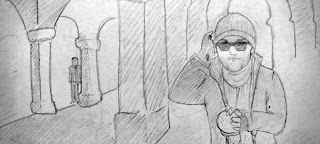

Zubasu was positioned much closer in the final product as we found that he was too far away for the audience to notice in his previous position. We also decided not to have the sunglasses and the burger in the end for practical reasons.


Instead of casting the earpiece into the coffee we opted for the crush-under-the-foot tactic, as it looked infinitely more dramatic and built up the pace further.


Unfortunately we couldn't film this shot behind the pillars as we intended, as it made Yung look too small and insignificant.


In the end we did not position this shot so that Richard was in the background as he looked too small and it was too hard to choreograph. However it would have looked very good.


We decided that it would look better if Zubasu slowly advanced from the background of the shot as it matched the previous shot and built up the tension further.


This shot is almost exactly how we pictured it, although it would have looked good if he's fallen between the two spurts of water, however this was not possible.

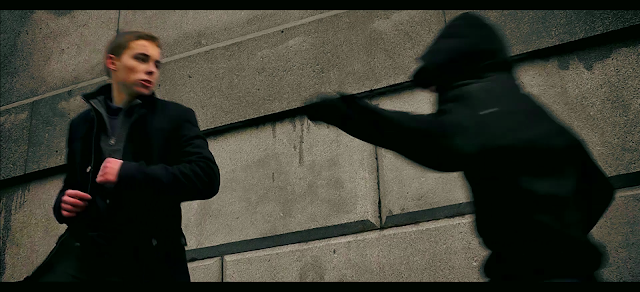


This shot we got very close to, although the final version was much closer to the tunnel then we thought was possible, so this was a very good change. It ended up just as we had visualised it.


In this we decided to switch around the camera angle when they came off the train, this was in order for the following shot to look successful, as there were only little window grates on one side of the roof.


Here you can see that the grate was much bigger than we had previously thought, and you could see the full body through the grate. This turned out to be beneficial, as the audience could actually tell who was walking past the grate.


This shot is pretty much exactly how we planned it. Even the position of Davidson's legs is exactly the same as the animatic.

Another very similar shot that worked out exactly how we planned. These two shots are a testament to the intense planning that went into producing the final piece.


Here Davidson is slightly further away than we had hoped so he looks slightly insignificant, but it still looks pretty similar.


Although this shot is slightly further back than we had previously anticipated, I believe that it looks far better, as you can see more of the location in the background, which helps to orientate the audience.


We used a different suitcase in the final product as we felt that it looked more stylish to have a suitcase with a strap that goes over your shoulder. If the audience were to look carefully they would see Yung in the background as in the storyboard.


Zubasu was positioned much closer in the final product as we found that he was too far away for the audience to notice in his previous position. We also decided not to have the sunglasses and the burger in the end for practical reasons.


Instead of casting the earpiece into the coffee we opted for the crush-under-the-foot tactic, as it looked infinitely more dramatic and built up the pace further.

Unfortunately we couldn't film this shot behind the pillars as we intended, as it made Yung look too small and insignificant.


In the end we did not position this shot so that Richard was in the background as he looked too small and it was too hard to choreograph. However it would have looked very good.


We decided that it would look better if Zubasu slowly advanced from the background of the shot as it matched the previous shot and built up the tension further.


This shot is almost exactly how we pictured it, although it would have looked good if he's fallen between the two spurts of water, however this was not possible.

The change from fighting in the lift to fighting on the stairs occurred as there was a cleaner by the lift who told us not to film there. Instead we had to quickly choreograph the fight on the steps nearby, whilst getting some strange looks from passers-by.


Dying in the position of a gun
was improvised on the day, and we thought that it was a very dramatic death
position.
Subscribe to:
Posts (Atom)